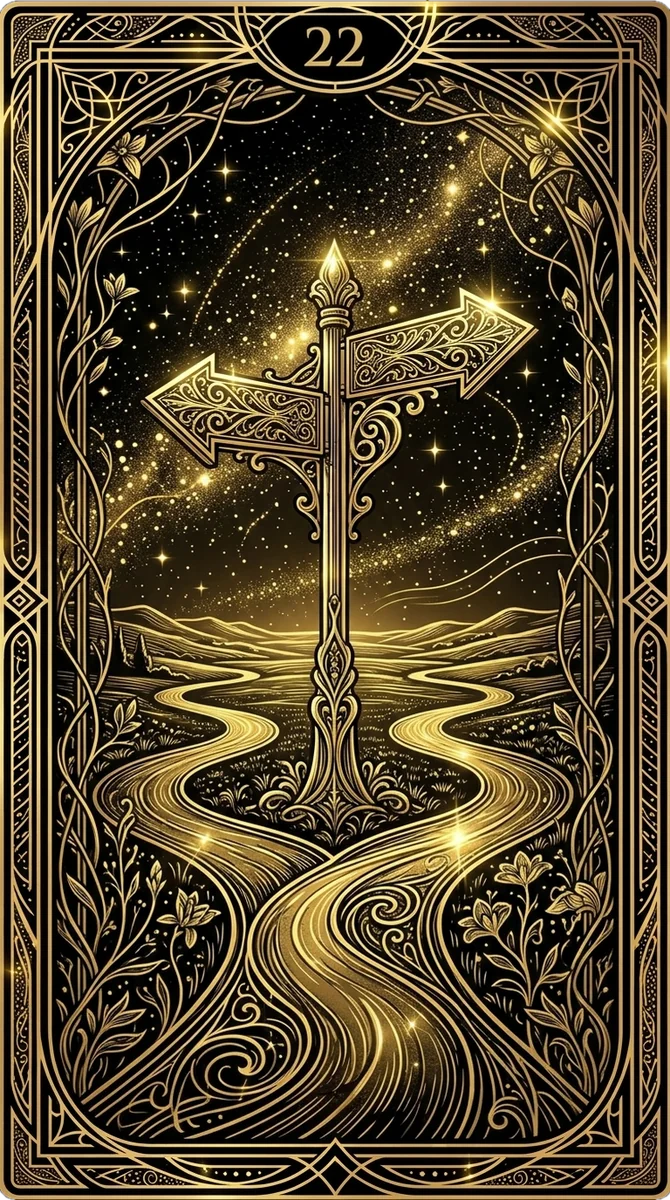
A signpost with two arrows; at its foot the road splits in two. Playing card: queen of diamonds. The Crossroads puts you before a choice: you cannot walk both roads at once.
Crossroads: meaning
The Crossroads is the card of choice: there are several options before you, and the decision is yours. That is good news, because there is a way out and more than one. The card asks you to weigh the paths and not to delay, or circumstances will choose for you. Sometimes it points to two parallel projects, two people or a journey with changes. The neighbouring cards show which path is easier: the Clover or the Sun nearby says the right decision will come quickly. In a yes-or-no question the Crossroads says it depends on your choice.
Crossroads in readings by theme
What Crossroads says in this site's three-card readings: one question from each theme, with the card's position in the spread. The answer changes with the question and the position.
The need to decide, rather than a fresh romantic gesture, will bear on you. A second person, a second job, a journey, an offer that cannot sit with the present form, will force a turn. Drag it out, and chance makes the choice. Name your terms aloud, and the road grows easier to see. Advice from someone else may confuse you, but it will not replace a decision of your own. Two plots side by side cannot be held for ever without loss. The outside fork is louder here than an inward “we’ll sort it later”. Chance will choose worse than you would.
Holding both options until the terms spoil is the catch. While nothing is chosen, each package can be worsened, or the calendar can be left to decide. Outside advice confuses the matter and does not choose for you. A second person among the interests easily becomes a hidden obstacle: you are bargaining over more than one deal. Press for a single answer without naming your own, and both sides grow more muddled. The obstacle is the missing decision. Choose one package this week, or the calendar worsens both and leaves you no document.
Wanting both at once gets in the way. You pull two wishes, two people, two formats, and not one of them receives its full move. The timetable begins to choose for you, usually for the worse, and advice from someone else muddles it further. What blocks you is that the choice is still unmade. While both ways count as obligatory, fulfilment stalls halfway. The push of “I want all of it at once” is the obstacle. Two ways held as obligatory together give neither wish its full move, and a calendar that is not yours begins choosing for you, and choosing worse.
Delay is what stands in the way. Until one line is taken, the bond serves both and therefore travels along neither. A choice made for you by someone else blocks the way too: family, habit, fear of giving offence if you name which variant is yours. The relative may honestly prefer not to decide in your stead, and from that they look evasive. Uncertainty itself is the obstacle. It stays convenient until it turns into a manner of living in which you are kin only in talk about the future.
Do not keep both moves going from fear of giving offence by a choice. Do not wait for a little more news to remove one door of its own accord. Do not hand the decision over to tiredness. Avoid the search for a third path that would suit everyone and touch nobody: no such path exists. And do not seize the first thing that offers, without having compared the price. Delay costs more than a mistake here. A mistake can still be put right. A silence drawn out cannot. For today, step round the decision to hold both paths equal right through to evening: the day will split in two, and tiredness, together with chance, will make the choice.
The morning sets two matters at once, and both look alive. Do not leave the house holding them as equals: the day will split in two. At breakfast, write down what each path costs, and close at least one of them for today. A third way, convenient for everyone, will not appear. The first hours are for a choice, and for one clear decision. Over tea, choose one path for today and close the second at least until evening, so the morning leaves the house in a single direction and the day does not split at the doorstep.