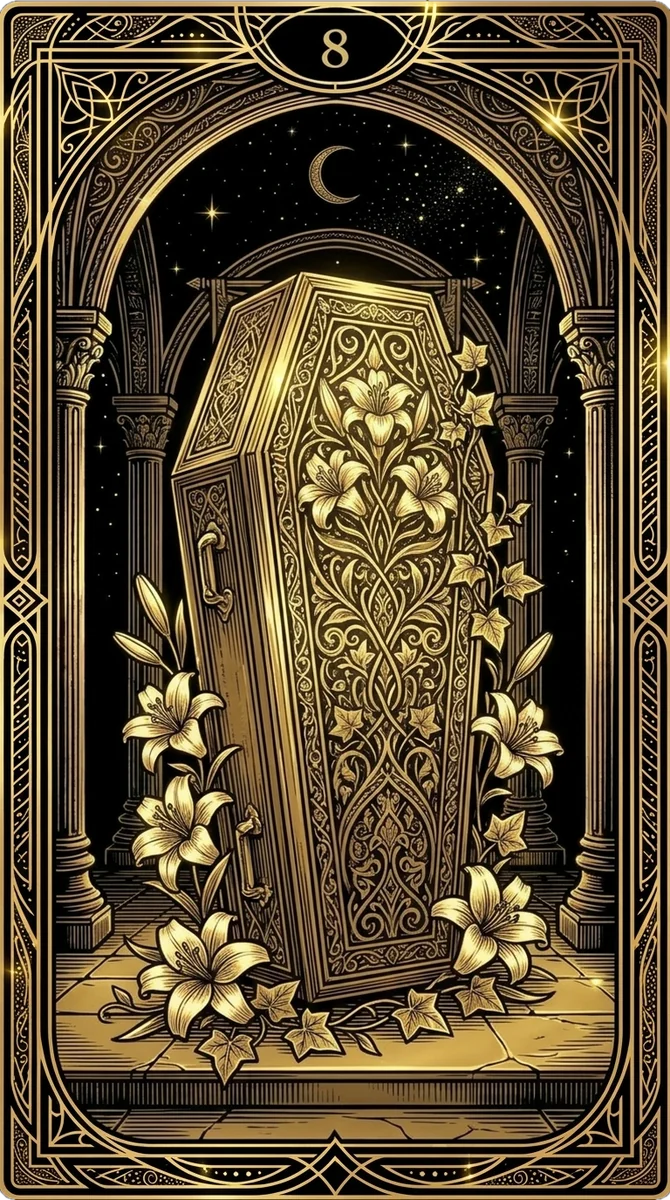
Keywords: an ending, the close of a chapter, a pause, change
The picture
A carved coffin stands beneath an arch, surrounded by white lilies and ivy. Playing card: nine of diamonds. The card speaks of an ending, not of death: of something that has run its course and has to go.
Coffin: meaning
The Coffin means an ending: something is coming to a close and there is no point fighting it, whether a job, a relationship, a habit or a period of life. It may be hard, but it makes room for the new. Sometimes the card speaks of low energy, sadness or stagnation, when nothing seems to move. Next to the Clover or the Sun the ending turns out for the better; next to the Child it leads into a new beginning. The pause will not last for ever. In a yes-or-no question the Coffin says no.
Coffin in readings by theme
What Coffin says in this site's three-card readings: one question from each theme, with the card's position in the spread. The answer changes with the question and the position.
The outcome is the end of this plot, not its flowering. The triangle, the jealousy, or the outside bond in its old form comes to a stop. A place for something new is not promised straight away: the pause has to finish first. After that your couple either breathes out and remains without this shadow, or finds that without the old chapter it has nothing of its own to hold. No loud scene is set. A stop is set. There will be no return of yesterday's intrigue.
Do not revive a role that has closed, and do not talk everyone back into the old rhythm. Put a calm full stop to the task: say what is finished, and what you will no longer carry in the former shape. Do not apologise for the pause as though it were a fault. Should another patch appear later, enter it as something new, not as a continuation of what has been used up. Hauling an empty task by heroics only fixes the picture of a person already written off that subject.
The end of the week fixes the completion. A question that has finished as a form does not come back on Friday. Room for something else does not appear at once, and often only after the weekend. The finish feels heavy only for those who were waiting for the old thing to go on. For everyone else it is a breath let out: there is no need to haul what is already closed any further. No loud event stands at the finish. There is a quiet in which the week honestly ends its chapter. By the weekend the Coffin leaves the quiet of a closed chapter, and there is no further need to haul what is closed.
Do not try to revive the old alliance with persuasion, and do not declare war on the silence. Accept the pause: fewer messages, and no testing of the closeness you used to have. If they step forward later of their own accord, the talk will be a new one, not a continuation. If they do not, let the matter go without a scene. Ending a stage does not turn them into a foe. It does not leave them a friend in the old shape either. Treat them as a person whose stage is already closed. Such a stage asks to be honoured with silence, and any new conversation starts only from their side.
The first option closes an old form: a role, a habit, or an agreement that has already run its course. The weight is real, and so is the space it clears. It is an honest road if you have stopped trying to bring yesterday back, and a harsh one if you are still inside that chapter and you treat a pause as disloyalty to the work. No celebration comes with the choice. It puts a stop where the old form has already fallen silent. Say aloud exactly what you are ending, and do not return to it in the coming month.
The evening sums up the stop. Fewer messages, less ritual, more honest tiredness. Do not check before sleep whether “perhaps it is not the end yet”. Name what is closed, and do not carry it into tomorrow. A night review aimed at starting it up again only lengthens the pause. Sleep after a full stop is easier than sleep after a hope you yourself do not believe. In the evening, draw a line under what is finished and do not call it to a night review, leaving sleep the right to close the day with no heroic continuation of an empty rhythm.