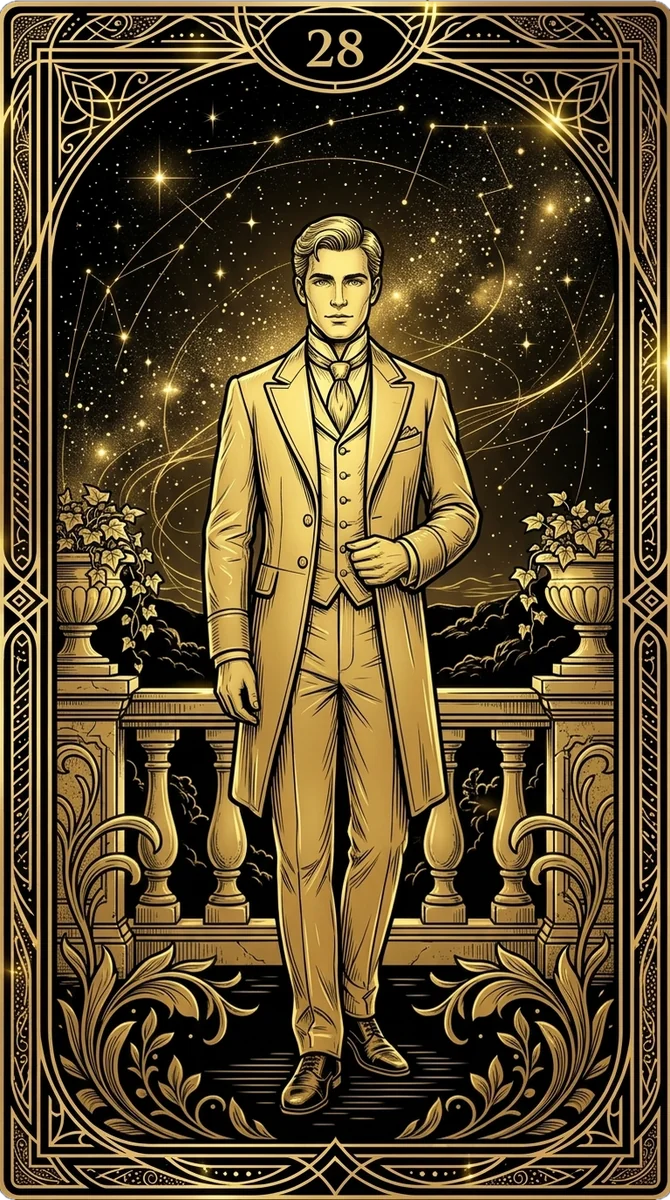
A man in a long frock coat stands by a balustrade against a starry sky. Playing card: ace of hearts. In classic Lenormand this is the card of the person asking, if that person is a man.
Man: meaning
The Man is the central figure of the spread. If you are a man, it is you, and the cards around it describe your situation. If not, it is the main man in your life: a partner, a husband, a close friend, sometimes a father or a boss. The card speaks of action, decisiveness and responsibility. The neighbouring cards describe what this man is like and what is happening to him: next to the Heart he is in love, next to the Ship he is leaving, next to the Fox he is insincere. In a yes-or-no question the Man is neutral, and the neighbouring cards decide.
Man in readings by theme
What Man says in this site's three-card readings: one question from each theme, with the card's position in the spread. The answer changes with the question and the position.
What this man feels is concrete. He is drawn to you, and he does not hide the pull in a long stretch of doubt: he wants to matter, to be useful, to be the one chosen. Tenderness is there. It shows in what he does and in his presence, not in endless talk about shades of feeling. If he is in love, the attention makes it plain. If he has cooled, there will be no theatre. He simply grows drier. Just now he wants to act because of you, and to turn that into a deed.
A man will bring the offer, or he will be the one to say it aloud. A former colleague, a boss, a client, a relative with a hand in the matter. He is someone who acts. Either he asks you in directly, or he never asks at all, and there is no drawn-out performance between the two. Speak to whoever can actually decide, not only to whoever feels for you. A letter may arrive, yet the weight lies in his word and in what he does. Until he speaks, the post is not open, however long it has been sitting on a website.
At the destination, what he does matters more than the mood of the threshold. Either he takes daily life on himself, and the first day is then in good order, or he keeps feeding you “I will think about it”, and settling stands still. Another man may step in with advice and delay the keys, the work, or the decision. Nothing there shifts until he acts. Waiting for him to read your silence is pointless. You need one plain sentence: what you need, and what you will take on yourself. Say it outright, or his pause will leave the keys and the decision for a later time.
A particular man is talking, not a crowd speaking as one. A partner, a close friend, a father, a boss: the voice that matters most to you. He comes straight to the point, in short judgements, and he does not circle hints for long. He would rather name the deed than sit for an hour taking a feeling apart. This is not the shared whisper of a group, and it is not rumour with no face on it. It is one man's voice, and after he has spoken the version grows more definite. Look for him among men who are used to answering, and to calling a deed by its proper name.
The substance rests on one particular man. He may be a partner, someone close, a father, a manager, the person who matters most in the question, or your own move if the question is about you and you yourself are a man. The content is practical: a decision, a responsibility, an action, not a long sorting-out of mood. The situation is not faceless. The person acting in it is a man, and it is read by what he does. A hint in place of a step is exactly why the question is still open.
The evening shows whether there was a deed. If there was, there is no need to chew his character over. If there was not, do not stage a hint at night in place of the morning sentence you never said. Tomorrow’s date is either set, or you are waiting once more for a rescuer. Close the day with one clear thought: who takes the step, and when. A mood by night matters less than that line. In the evening, record whether the deed happened, and close the day with no fresh circle of hints, leaving for tomorrow either a clear date or an honest conclusion that there was no move today.