I Ching: A Journey Through Millennia. The History of the “Book of Changes”
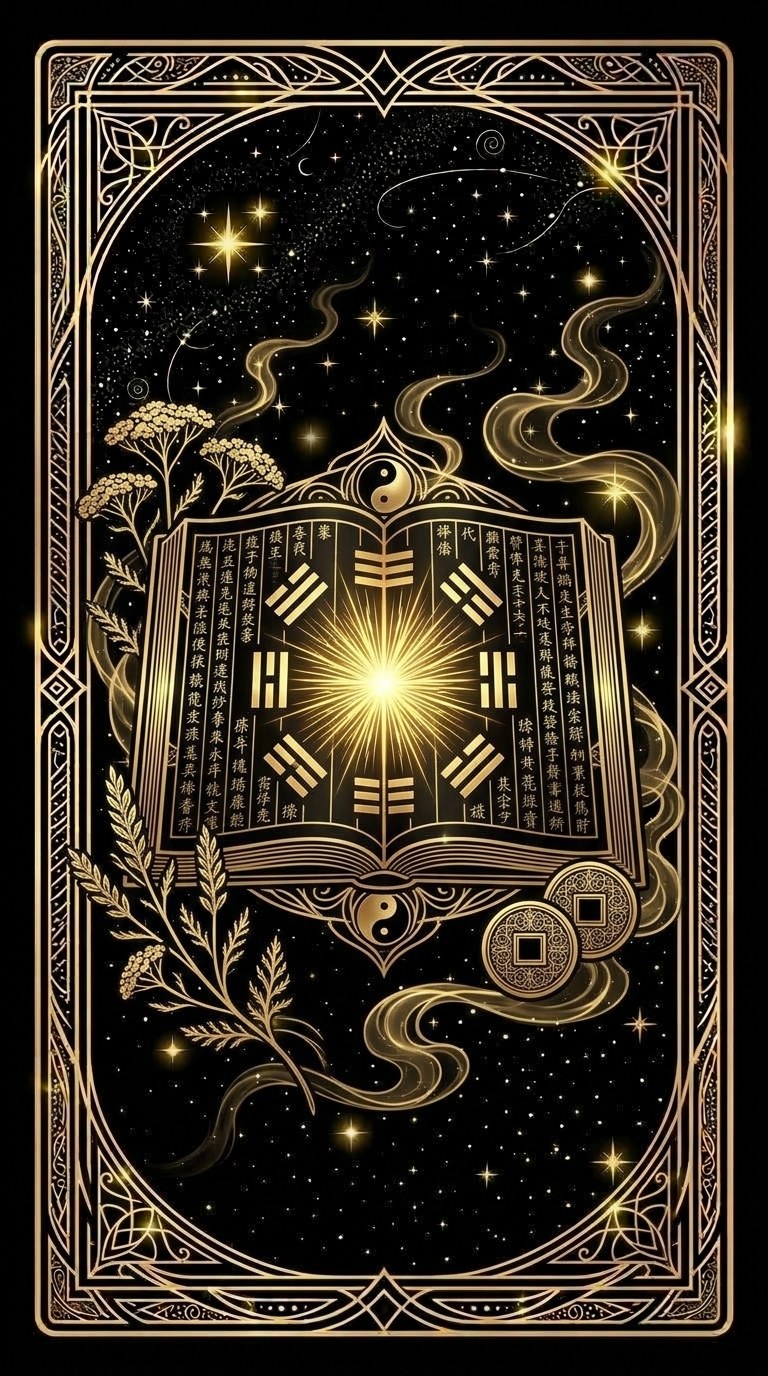
Among all the great texts left to us by antiquity, few can rival the depth, mystery, and influence of the Chinese Book of Changes — the I Ching. It is not merely a philosophical treatise, nor a simple divination manual. It is an attempt by ancient minds to digitize the universe, to frame the endless mutability of life within a strict mathematical and symbolic system.
Its history was not written by a single author. It was shaped over centuries, absorbing myths, the sweat of rulers, the wisdom of philosophers, and the ashes of burned libraries.
Chapter 1. The Tortoise Shell and the Gaze into the Heavens
According to Chinese tradition, the story of the I Ching begins long before the emergence of writing, in the age of the mythical emperor Fu Xi (around 2800 BCE). Legend tells that one day the ruler stood on the bank of the Yellow River. He studied the patterns of the starry sky, the tracks of birds on the sand, the lines of mountains and the flow of waters. Suddenly, from the river emerged a mythical dragon-horse, with strange symbols inscribed upon its back.
Inspired by this vision, Fu Xi created the eight trigrams (bagua) — combinations of three solid (Yang) and three broken (Yin) lines. These eight symbols became the alphabet of the cosmos: Heaven, Earth, Thunder, Wind, Water, Fire, Mountain, and Lake. Within them lay the entire nature of things, flowing from one state into another.
Centuries later, during the Shang dynasty, priests used these concepts for divination. They heated bronze rods and pressed them against tortoise shells and ox scapulae; by reading the cracks that formed, they interpreted the will of Heaven. It was an era of raw, primordial magic — the soil from which a great text would grow.
Chapter 2. The Prisoner Who Created a Universe
The book acquired its classical form — composed of hexagrams (six lines) — during one of the darkest periods of Chinese history, at the end of the brutal Shang dynasty (around 1046 BCE).
The ruler of the western lands, King Wen, a man of great intellect and justice, incurred the wrath of the tyrant Di Xin. Wen was thrown into prison in the city of Youli. Years of confinement could have broken him, but instead he turned inward, seeking freedom within.
In the dimness of his cell, Wen took the eight ancient trigrams of Fu Xi and began combining them. Eight multiplied by eight — 64 hexagrams emerged. Each described a specific life situation, a stage of growth or decline. Wen gave them names and wrote short, enigmatic aphorisms for each, filled with poetic imagery of dragons fording rivers and wells without water.
Later, his son, the Duke of Zhou, completed his father’s work. He added commentaries to each individual line (yao) within the hexagrams. Thus the magic of cracks on tortoise shells transformed into the Zhou Yi — the “Changes of Zhou,” a text rich in morality and strategy.
Chapter 3. Wings for the Dragon
Centuries passed. The era of Spring and Autumn arrived — a time of wars and flourishing philosophy. During this period, the greatest sage of China, Confucius (Kongzi), turned to the Book of Changes.
Tradition says Confucius studied the I Ching with such dedication that the leather straps binding the bamboo slips of his scroll wore out and snapped three times. Before Confucius, the I Ching was primarily an oracle. After him, it became a profound philosophical system.
It is believed that Confucius and his disciples wrote the Shi Yi — the “Ten Wings.” These commentaries revealed the hidden meaning of the hexagrams through the lenses of morality, duty, cosmology, and the interplay of Yin and Yang. The “Ten Wings” lifted the I Ching into the heavens, transforming a manual for divination with yarrow stalks into a mirror of universal harmony.
Chapter 4. Fire and Ashes of an Empire
In 213 BCE, the ruthless unifier of China, Emperor Qin Shi Huang, issued an order that shook all scholars: burn all philosophical and historical books so that history would begin only with him. Thousands of scrolls turned to ash; hundreds of scholars were buried alive.
But the I Ching survived.
The emperor’s decree contained a small exception: books on medicine, agriculture, and divination were not to be destroyed. Since the Book of Changes was officially classified as a divination manual, it was spared. Thanks to this bureaucratic detail, one of humanity’s greatest intellectual monuments survived cultural genocide and reached the Han dynasty, where it was canonized as one of the most important Confucian classics.
Chapter 5. The Journey West and the Binary Code
Europeans first encountered the I Ching in the 17th century through Jesuit missionaries. This meeting had astonishing consequences for Western science.
The great mathematician Gottfried Wilhelm Leibniz, creator of the binary numeral system — the foundation of all modern computers — once received a letter from the French Jesuit Joachim Bouvet. Attached was a diagram of the I Ching hexagrams. Leibniz was stunned: in the alternation of solid and broken lines he saw a perfect illustration of his binary system — zeros and ones! Ancient Chinese sages, unknowingly, had mathematically described the world millennia before the birth of computer science.
In the 20th century, the book gained new popularity in the West thanks to Richard Wilhelm’s translation. The renowned psychologist Carl Gustav Jung, who wrote the foreword, saw in the I Ching a confirmation of his theory of synchronicity — meaningful coincidences connected not by cause and effect, but by deep inner significance.
Conclusion: Eternal Change
Today, more than three thousand years later, the Book of Changes still rests on the shelves of millions around the world. Business leaders consult it for strategic insight, writers seek inspiration (as did Philip K. Dick while writing The Man in the High Castle), and psychologists and philosophers explore its wisdom.
The I Ching teaches us the universe’s greatest law, which paradoxically states: the only thing that remains constant in this world is change itself. And as long as the world continues to change, the ancient hexagrams of King Wen will continue to reflect its endless dance of Yin and Yang.