The Whisper of Ages: A Journey of Tarot Cards Through Time
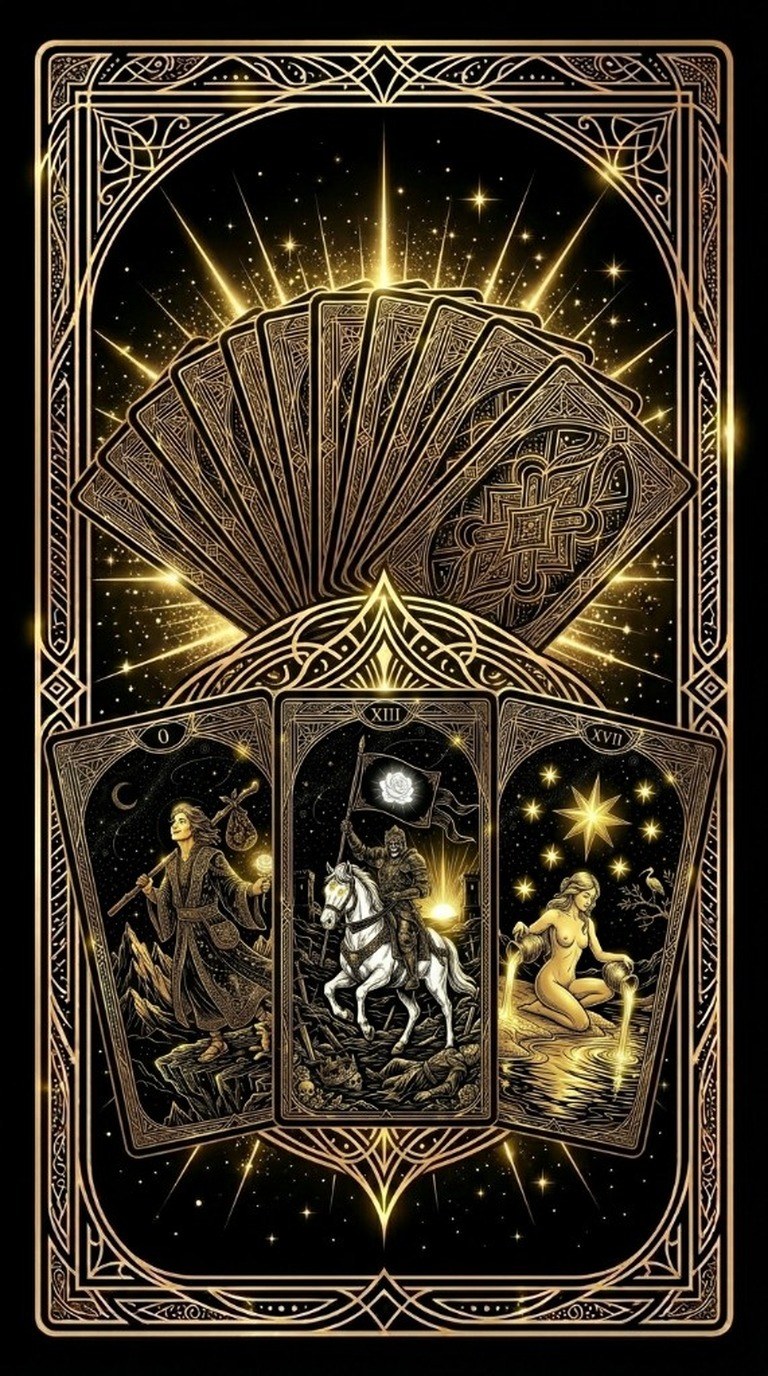
When we gaze at the vivid, enigmatic images of Tarot cards, our imagination eagerly conjures scenes of ancient lore: priests in the temples of Old Egypt guarding secret knowledge from the uninitiated, or Romani wagons creaking along the dusty roads of medieval Europe. Yet the true history of these cards, stripped of layers of mystification, proves no less captivating than the boldest legends.
Act One: The Splendor of the Italian Renaissance
Contrary to popular myths, Tarot did not descend to us from the walls of Egyptian pyramids. Their cradle was Northern Italy in the early 15th century — the dawn of the Renaissance, an era of flourishing arts, intrigue, and extraordinary luxury.
At first, these cards had nothing to do with foretelling the future. They were a salon amusement for aristocrats, a card game known as Tarocchi or Trionfi (Triumphs). The wealthiest families of the time, such as the Milanese dukes Visconti and Sforza, commissioned artists to create unique decks. Painted by hand, adorned with gold leaf, these cards cost a fortune.
The structure of the game was already close to what we know today: four suits (swords, cups, coins, and wands) and special trump cards decorated with allegorical figures — Death, Love, the Wheel of Fortune. These images were not secret ciphers; they represented archetypes and Christian virtues familiar to any educated person of the era. Tarot was a mirror of its time, reflecting the worldview of a noble Italian.
Act Two: The Occult Turn in France
Three centuries passed. Tarot cards spread across Europe, transforming from exclusive works of art into a popular game printed on inexpensive cardboard (the most famous being the “Marseille” deck). And then, in the late 18th century, an unexpected shift occurred.
France stood on the brink of revolution, and the minds of the enlightened public were enthralled by mysticism, Freemasonry, and the mysteries of the East. In 1781, Swiss mason and scholar Antoine Court de Gébelin published his multivolume work The Primeval World. In it, he confidently proclaimed that Tarot was none other than the sacred “Book of Thoth,” saved from the burning libraries of Ancient Egypt. Although Egyptian hieroglyphs had not yet been deciphered and Gébelin’s theory lacked scientific basis, the seed fell on fertile soil.
Jean-Baptiste Alliette, a former grain merchant who adopted the pseudonym Etteilla (his surname spelled backward), took up the torch. He became the first professional tarot reader in history, created the first deck designed specifically for divination, and published detailed guides on interpreting the cards. It was Etteilla who forever linked Tarot with astrology and fortune-telling. The cards began to speak the language of the future.
Act Three: British Mysticism and the Birth of a Legend
The true revolution that shaped modern Tarot occurred at the turn of the 19th and 20th centuries in foggy London. The cards came into the hands of members of the Hermetic Order of the Golden Dawn — a secret society devoted to magic, alchemy, and Kabbalah.
French occultist Éliphas Lévi had earlier brilliantly connected the 22 Major Arcana with the 22 letters of the Hebrew alphabet and the Tree of Life. But the British went further. In 1909, prominent Order member Arthur Edward Waite set out to create a new deck. He entrusted the task to artist Pamela Colman Smith, a woman of unconventional vision and remarkable talent.
Their collaboration, known today as the Rider–Waite–Smith deck, was groundbreaking. For the first time in history, all 78 cards — including the Minor Arcana — received detailed narrative illustrations. Where the “Three of Swords” had once been merely three drawn blades, it now became a heart pierced by three swords against a stormy sky. This clarity and psychological depth made Waite’s deck the most popular in the world, accessible without memorizing complex occult treatises.
Epilogue: A Mirror of the Human Soul
In the 20th century, Tarot underwent yet another transformation. Thanks to the works of Carl Gustav Jung, the images of the cards began to be seen not as magical tools for predicting the future, but as a set of universal human archetypes.
Today, Tarot is a kaleidoscope of meanings. For some, it remains a mystical oracle; for others, it is a tool of self-discovery, a visual diary, or metaphorical cards that help psychologists explore the subconscious. And for artists around the world, creating their own Tarot deck has become a way to express their vision of reality.
Having begun its journey as a gilded toy of Italian aristocrats, Tarot has become a universal language of symbols through which humanity continues its dialogue with itself.